Why Orthostand

It's not the work. It's your posture.

In foot care, a significant part of every day is spent forward-bent and still, low to the ground. The effort isn't the problem, the stillness is. Here's what it does, and why it's worth changing.

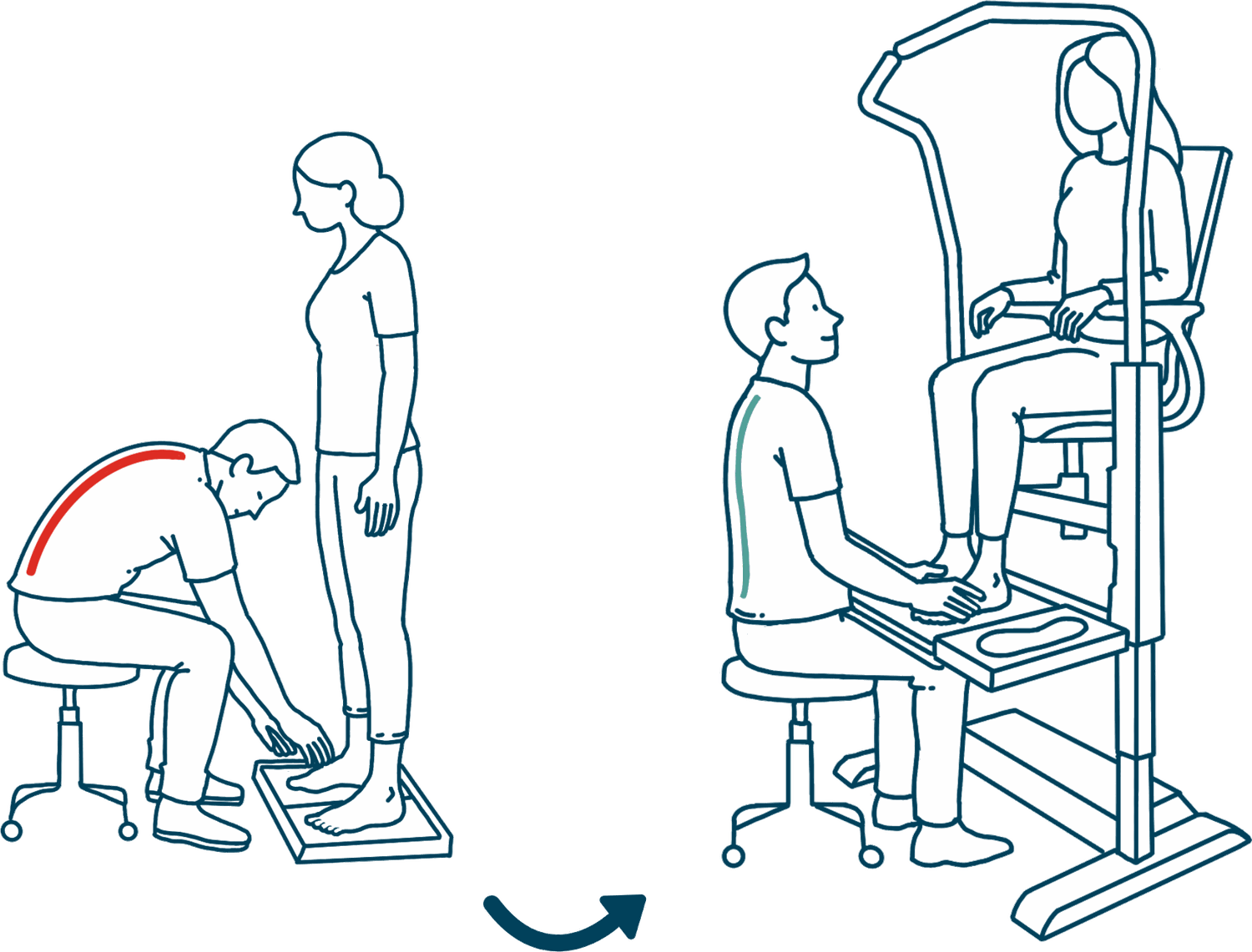
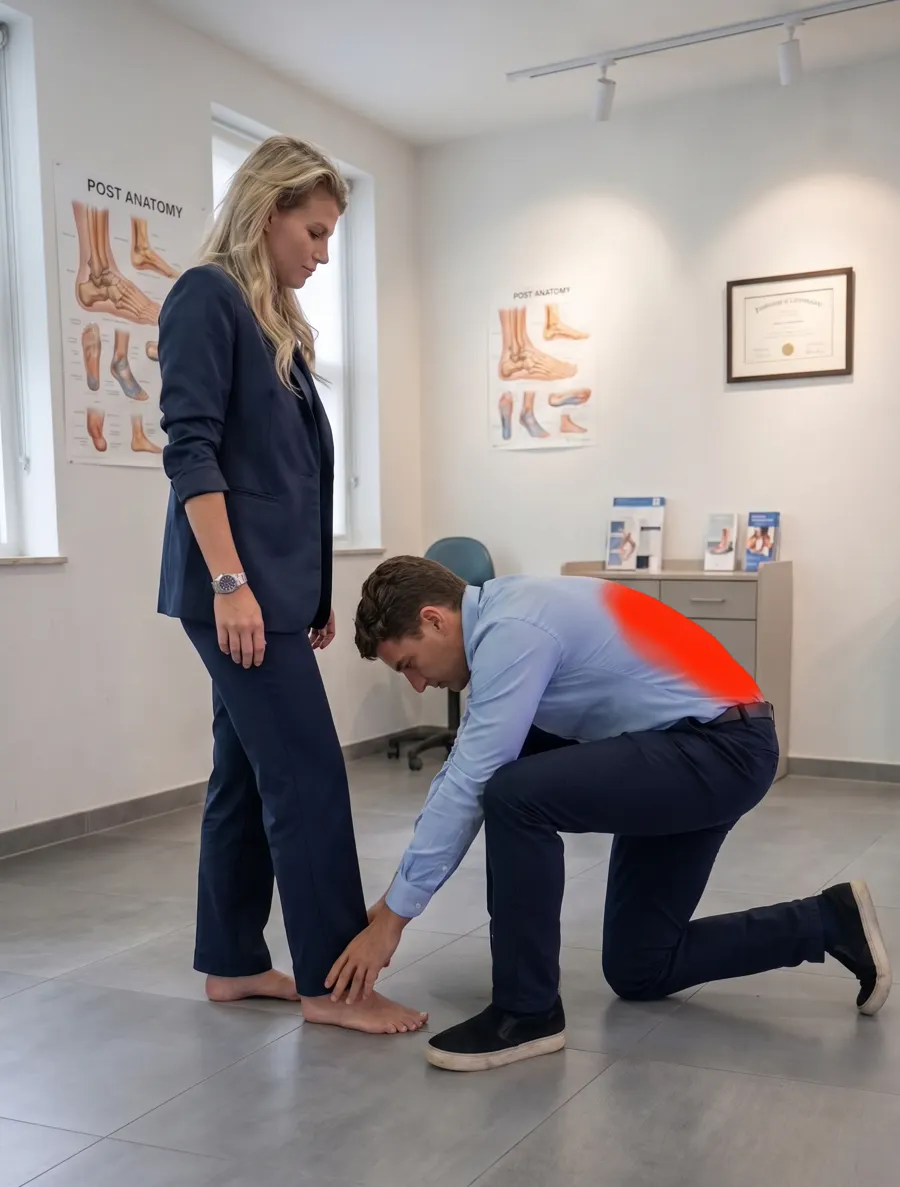
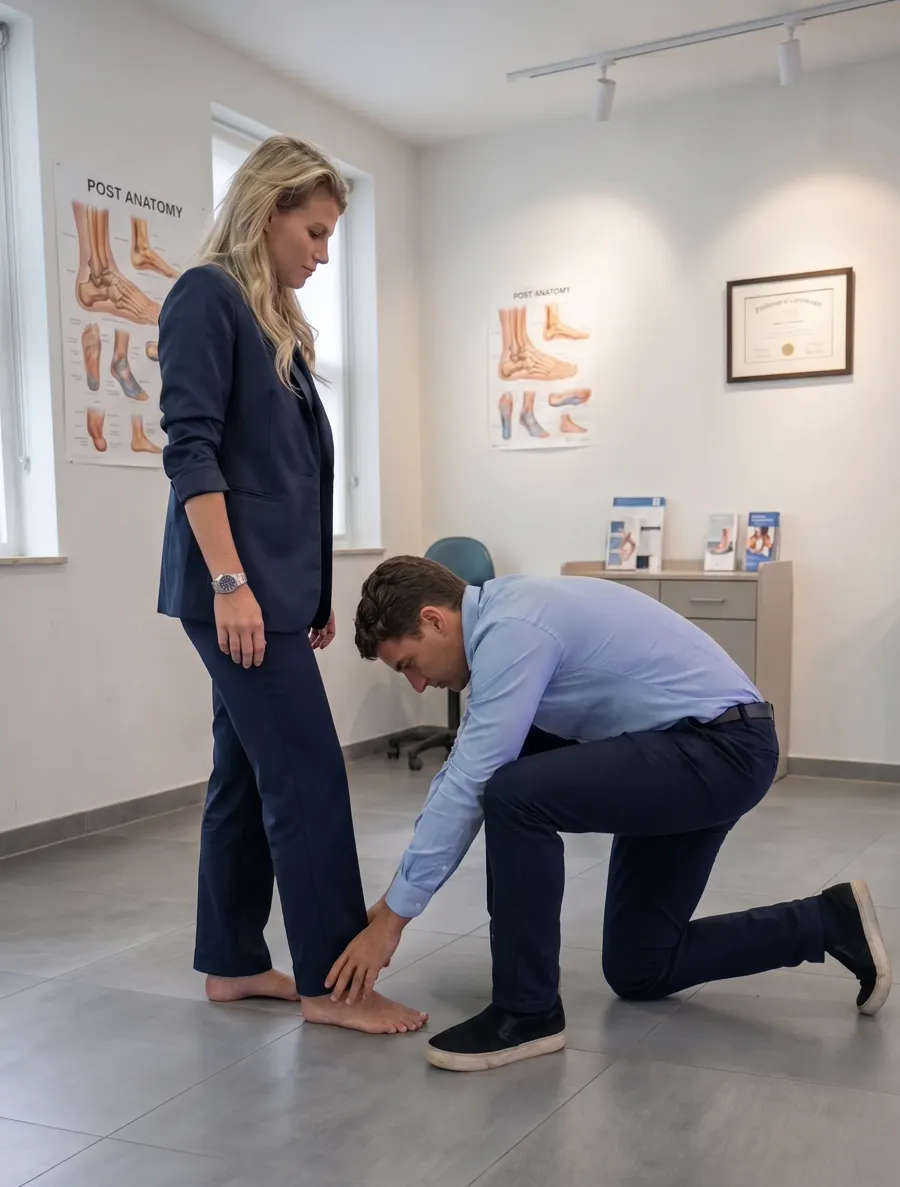
Left: a specialist bent forward and kneeling to reach a standing client's feet, spine curved under strain. Right: the same specialist sitting fully upright while the client is raised on the Orthostand.
Before we get to the science

Is this you?

You stretch your back between clients without thinking about it. You kneel without deciding to kneel, because it is just how you reach the foot. And somewhere along the way you told yourself it comes with the job.

Almost every specialist recognises this. Almost none of them call it a problem.

The mechanism

Stillness is the problem, not the effort

A treatment takes fifteen, twenty minutes. Multiply that by a full day of clients, a working week, a career, and most of your professional life is spent holding one position, low to the ground.

Your muscles do not mind hard work. They mind holding still. A muscle that alternates between contracting and relaxing keeps its own blood supply moving. A muscle that holds one position does not.

MovingHolding still
Moving

Motor units take turns

Holding still

The same fibres fire continuously

Moving

Blood flows with the rhythm

Holding still

Sustained tension compresses the vessels

Moving

Heart rate rises with the effort

Holding still

Heart rate stays low

Moving

Oxygen keeps pace with demand

Holding still

Delivery stays limited

Moving

Waste clears between contractions

Holding still

Waste accumulates and stays

Nothing comes in. Nothing goes out.

The result is micro-damage in muscle tissue that never fully repairs. That is the starting point of every musculoskeletal disorder in this profession.

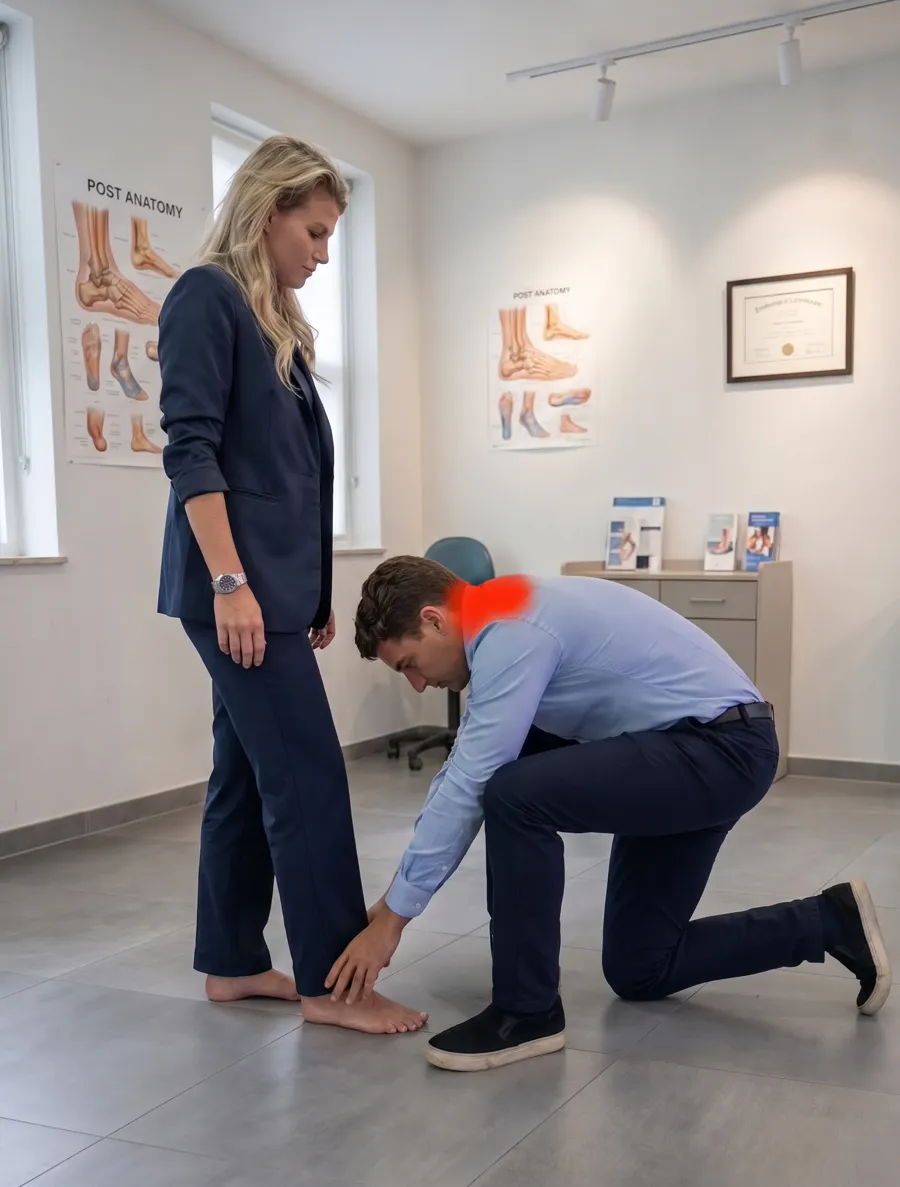
Notice the head, too: to keep the working area in view, the neck is forced far forward and down, an unnatural position relative to the client, held still for the length of every treatment.

It is measurable

A Danish study followed 944 workers for four years, measuring their posture with accelerometers and their sick leave through the national register. Every five extra minutes per day spent bent forward beyond 30 degrees was associated with a 4% higher risk of long-term sick leave. Beyond 60 degrees, 8%.

Those workers averaged 40 minutes a day bent forward. Foot care is not an average job.

Gupta N et al. Does occupational forward bending of the back increase long-term sickness absence risk? Scandinavian Journal of Work, Environment & Health, 2023.

"Static strain is a silent killer. The damage builds slowly and unnoticed.", Hanneke Knibbe, IZZ / ZZP Magazine De Zorg

The full physiology, with references

The cost

Four places where it adds up

Musculoskeletal disorders are among the most common occupational health conditions in foot and lower-limb care, and among the least talked about.

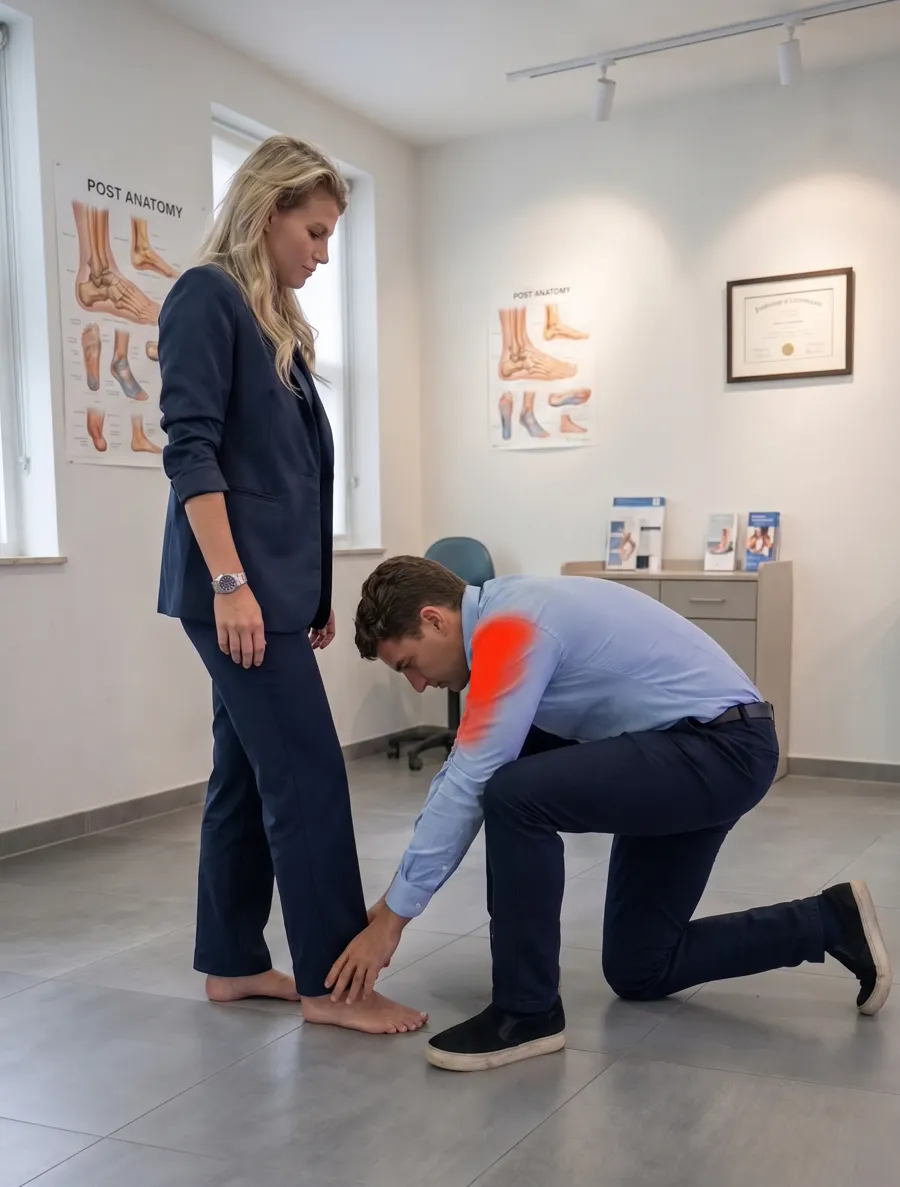
A specialist kneeling and bent forward, with the load points marked on the neck, shoulders, lower back and knee 1 2 3 4
1

Neck

Sustained forward lean means constant contraction. Over time: chronic tension and nerve compression radiating into the arms.

2

Shoulders

Raised shoulders during precision work restrict blood flow. Post-shift fatigue gradually becomes structural pain.

3

Lower back

Bent posture dramatically increases disc pressure. Higher risk of herniation at L4–L5 and L5–S1 over time.

4

Knees

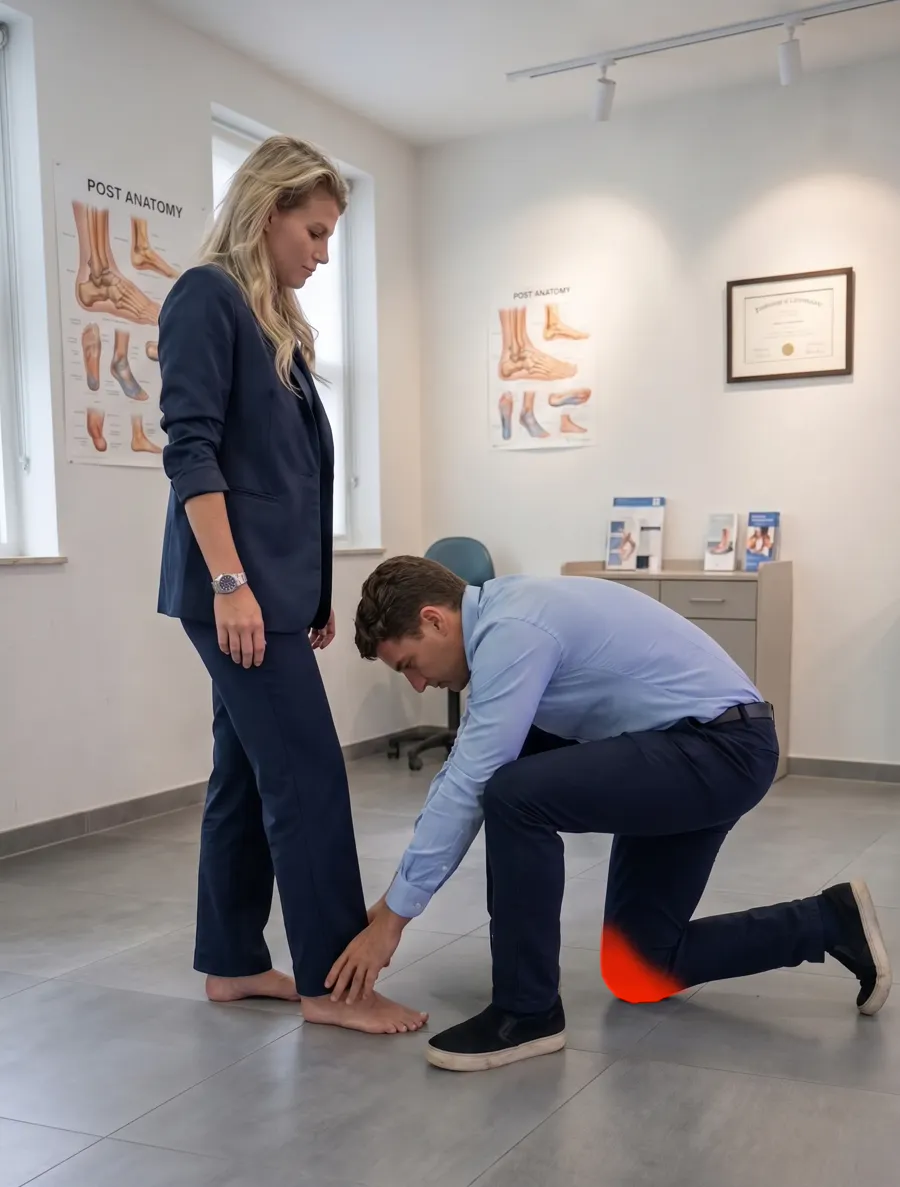
Kneeling crushes the kneecap, bursa and soft tissue against the floor; the forward lean adds shear. Over years: bursitis, cartilage wear and osteoarthritis.

The rear knee under load: weight, compression force, shear force and ground reaction force
4

The rear knee, in detail

When you work with one knee on the ground and the other leg forward, the rear knee bears nearly twice the load:

1Weight. Your bodyweight travels straight down through the femur into the knee joint, creating significant load on one knee.
2Compression force. The kneecap, bursa and soft tissues of the rear knee are crushed between bone and hard floor, this is why kneeling bursitis is endemic in foot-care work.
3Shear force. The forward lean over the patient's foot turns the knee into a pivot point, pushing and pulling the joint internally. Cartilage and meniscus absorb it day after day, wearing down faster.

Over the years this cumulative load damages cartilage, menisci and the bursa, leading to osteoarthritis, bursitis and chronic knee complaints.

The evidence

This is not something that happens later

The largest study of its kind surveyed 948 podiatrists across Australia, New Zealand and the United Kingdom. The findings are hard to read as anything other than a warning.

76% reported work-related musculoskeletal pain during their career
45% of those injuries occurred in the first five years of practice
29% named the lower back as their most significant injury
58% told anyone about it

The second figure is the one that matters most. Nearly half of all injuries happen in the first five years, not at the end of a long career. Three quarters of those affected changed how they work as a result, while only 58% told a manager or colleague. The rest adapted quietly, and carried on.

Williams CM, Penkala S, Smith P, Haines T, Bowles KA. Exploring musculoskeletal injuries in the podiatry profession: an international cross-sectional study. Journal of Foot and Ankle Research, 2017.

If you employ specialists

Qualified staff are scarce, and the ones you train are the ones most at risk in their first five years. Practices that take ergonomics seriously report higher staff satisfaction and an easier time attracting new people in a market where qualified personnel are hard to find.

Read what practitioners say
The alternative

It does not have to work this way

The posture is the problem. So change the posture, not the person.

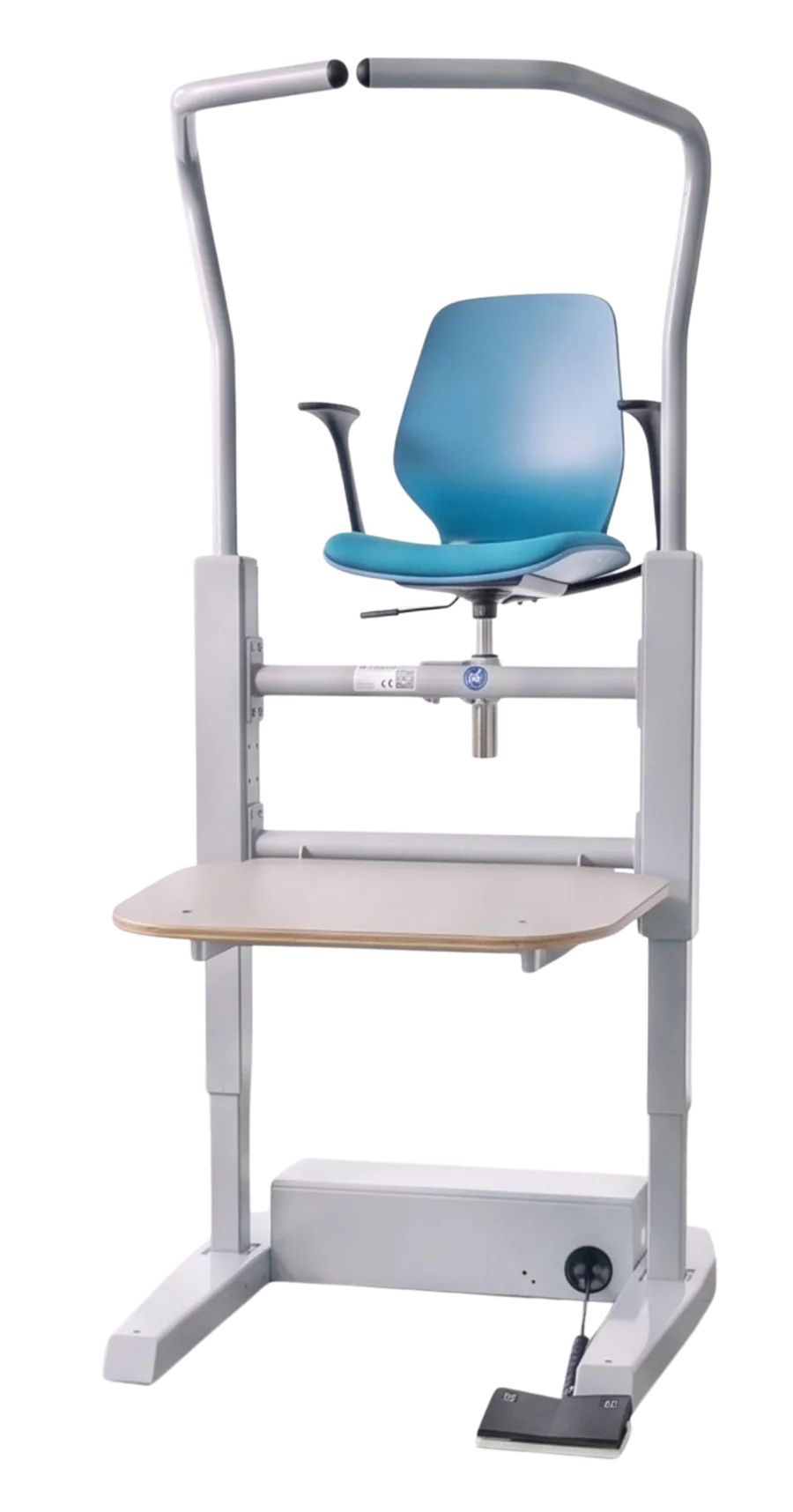
Everything on this page follows from one thing: the work sits at floor level and you go down to meet it. Reverse that, and the mechanism has nothing to act on. No sustained forward lean. No kneeling. No holding still at the edge of your reach.

  • Your back stays neutral. The client comes up to you, so there is nothing to lean over.
  • Your shoulders drop. Your arms rest on the platform instead of holding themselves up.
  • Your knees are out of the equation entirely. You are seated, not kneeling.

The principle is proven, not claimed

A German study measured the postures of twelve nurses during standard care routines. Working standing over a low bed, they spent 87% of the time bent forward. Raising the work to hip height and working seated significantly increased the time spent upright, and the more time they spent upright, the less strenuous they rated the work.

The researchers' conclusion: adjustable working heights and seating let care staff spend considerably more of their time in an ergonomic posture.

Freitag S, Ellegast R, Dulon M, Nienhaus A. The Effect of Working Position on Trunk Posture and Exertion for Routine Nursing Tasks. Annals of Work Exposures and Health, 2014.

Protect your health. Keep doing the work you love.

There's no obligation, only an open invitation to consider a better way of working.

Request information